

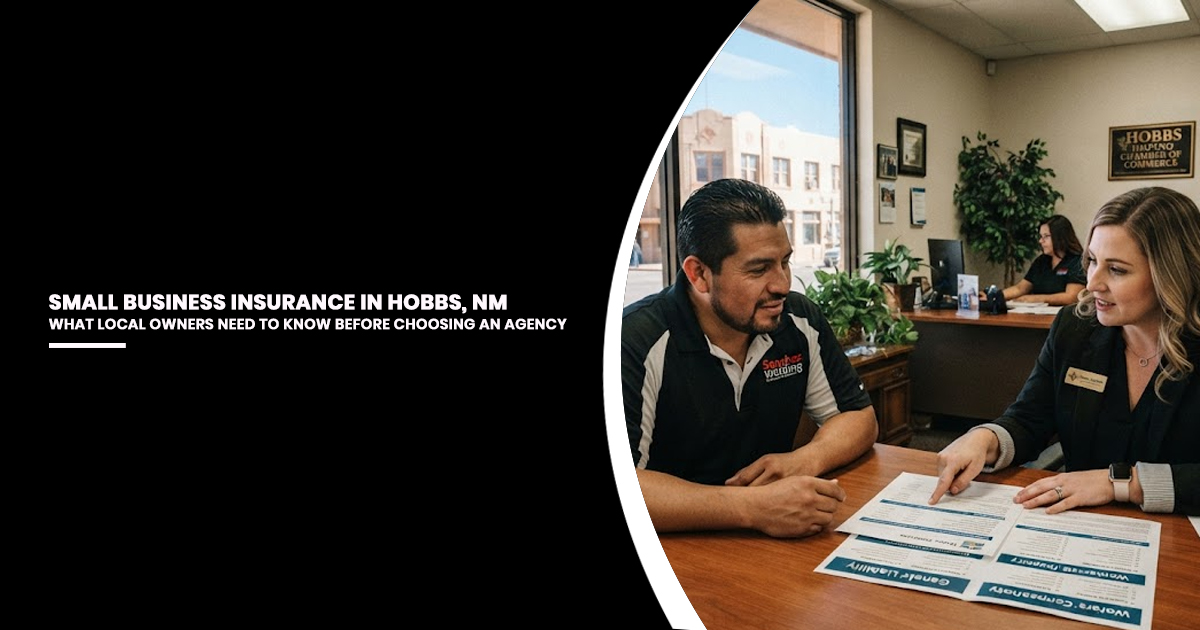
Small Business Insurance in Hobbs, NM: What Local Owners Need to Know Before Choosing an Agency
Picture a Hobbs oilfield contractor with three trucks, a welding rig, and a five-man crew running caliche roads out past Eunice. One rollover on a lease road, one crew member hurt on a job site, and suddenly the question isn’t “am I insured?” — it’s “am I insured for THIS?”
That’s the moment most business owners find out what their policy actually says. And by then it’s too late to fix.
The wrong agency doesn’t cost you a premium. It costs you the business.
Choosing small business insurance in Hobbs, New Mexico shouldn’t be another headache on a plate that’s already full. You’re already wearing a dozen hats. This practical guide walks you through picking the agency that actually understands your commercial risk — written by a team that’s been doing exactly that in Lea County since 1972. Plainly, specifically, and for Hobbs.
Why Is Choosing a Commercial Insurance Agency Harder Than It Looks in Hobbs?
Commercial coverage isn’t one product — it’s five or six moving parts that have to fit your specific operation, and most owners can’t tell whether an agency actually understands their trade until a claim gets denied. A retail shop, an oilfield hauler, and a plumbing contractor need three completely different coverage stacks, even though they’ll all get quoted “business insurance.”
the price you’re quoted tells you almost nothing about whether you’re protected. Two agencies can hand you a general liability quote that looks nearly identical on paper, while one quietly excludes the exact exposure that’s most likely to sink you. In an economy built on energy, trucking, and the trades, the gaps that matter most in Hobbs are the ones a generic online quote never asks about.
The trade-offs most guides skip:
- Cheap vs. covered: The lowest premium usually means higher deductibles, thinner limits, or exclusions you won’t notice until you file a claim.
- Convenience vs. fit: A single-carrier agent is fast and simple, but you only ever see one company’s appetite and one company’s price.
- Generalist vs. specialist: An agency that mostly writes homeowners policies can technically sell you commercial auto — but they may not know how a radius-of-operation rule or a hired-and-non-owned gap plays out for a Lea County hauler.
So the real question isn’t “who’s cheapest?” It’s “who actually understands what I do for a living?”
What Factors Should Drive Your Decision About Small Business Insurance in Hobbs, New Mexico?
Your decision should be driven by five factors: the specific coverages your trade legally and practically needs, the agency’s depth in commercial lines, how many carriers they can shop, their local underwriting knowledge, and how they handle a claim. Coverage fit comes first — price is a tiebreaker, not the deciding vote. Get the coverage right and the savings follow; get it backwards and the “savings” evaporate the first time you file.
Most Hobbs small businesses end up needing some mix of the core commercial lines below. What you actually need depends on whether you own vehicles, employ crews, hold inventory, or run heavy equipment:
- Commercial general liability (CGL): Covers third-party bodily injury and property damage — the slip-and-fall customer, the pipe you burst in someone’s building. It’s the foundation, and it’s often required to sign a client contract or a commercial lease.
- Commercial auto: Required for business-owned vehicles. New Mexico’s baseline liability is 25/50/10 in 2026, but that legal minimum is nowhere near enough for a work truck fleet — most contracts and lenders demand far higher limits.
- Workers’ compensation: Covers employee injuries and lost wages. In New Mexico it’s mandatory for most businesses with three or more workers — and required for construction businesses of any size (more on that below).
- Business owners policy (BOP): Bundles general liability with commercial property (and often business interruption) for shops, offices, and storefronts that hold inventory or lease space.
- Heavy truck and motor carrier coverage: For haulers, water trucks, and rigs — this is its own specialty, with radius rules, cargo coverage, and federal filings a general agent may not handle.
Once you know which of these apply to you, the next question is whether the agency across the desk has actually written them for a business like yours.
What Does Commercial General Liability Actually Cover — and How Much Does It Cost?
Commercial general liability covers third-party bodily injury, third-party property damage, and the legal defense costs that come with them — a customer hurt on your premises, damage you cause to someone else’s property, and associated advertising injury claims. It does not cover your own employees, your own property, your vehicles, or professional mistakes — those need workers’ comp, commercial property, commercial auto, and professional liability respectively.
Cost-wise, small businesses pay a national average of roughly $45 per month for general liability, and Progressive reported an average of $79 per month with a $55 median in 2025. Most owners land somewhere in the $30 to $125 per month range, driven by industry, revenue, claims history, and limits. Real talk: an oilfield service company and a downtown boutique will not pay anything close to the same rate, and any agency that quotes you a flat number before asking what you do is guessing.
One detail worth knowing: the standard $1 million per occurrence / $2 million aggregate policy is the norm most contracts require, and doubling your limit rarely doubles your premium — it often adds only a modest amount for meaningfully more protection. That’s the kind of trade-off a good commercial agent walks you through instead of just emailing a quote.
How Do You Evaluate a Local Agency for Commercial Coverage in Lea County?
Evaluate a local agency on five things: commercial specialization, carrier count, local underwriting knowledge, claims advocacy, and whether they represent you or the insurer. An agency that mostly writes personal auto and homeowners is not the same as one that writes oilfield contractors and trucking fleets — the difference shows up the day you file a six-figure claim.
ask them to name the last three commercial claims they helped a client through, and what the sticking point was on each. A commercial specialist will have answers. A generalist will change the subject to price.
What to look for when you’re comparing agencies:
- Commercial depth: Do they routinely write commercial auto, workers comp, BOP, and heavy truck — or is business insurance a side line?
- Carrier access: Can they shop your risk across multiple companies, or are you stuck with one carrier’s appetite and one carrier’s price?
- Local knowledge: Do they understand Hobbs and Lea County exposures — energy sector work, caliche and highway driving, wind and hail on commercial roofs?
- Claims track record: When a claim gets messy, will a real person advocate for you, or will you be alone with a 1-800 number?
- Longevity: An agency that’s been in the community for decades has watched carriers come, go, and change their appetite — and knows which ones actually pay.
If an agency can’t clearly answer those five, keep looking. The savings from a cheaper quote won’t matter if nobody’s in your corner when it counts.
What Questions Should You Ask Before Signing a Commercial Policy?
Before you sign, ask exactly what’s excluded, whether your limits meet your contracts, how workers’ comp classifies your crew, and whether your vehicle radius and use are correctly rated. The exclusions page is where policies fail — and it’s the page most owners never read until a claim lands on it.
New Mexico workers’ comp is a common trap. The Workers’ Compensation Act applies to employers of three or more workers, and construction businesses of any size must carry coverage in New Mexico. Misclassify a laborer as a subcontractor, or assume you’re too small, and you’re exposed to fines plus the full cost of an injury out of pocket.
The questions worth asking out loud before you sign anything:
- “What’s excluded?”: Ask them to walk you through the exclusions page line by line, not just the coverage summary.
- “Do these limits satisfy my contracts?”: Many oilfield master service agreements and commercial leases demand specific limits and additional-insured wording. A missing endorsement can void a contract.
- “How is my payroll classified for workers’ comp?”: The class code drives your premium and your coverage. The wrong code can mean a denied claim.
- “Is my commercial auto rated for how I actually use it?”: Radius of operation, cargo, and driver records all matter. Under-disclosing to save a few dollars can wreck a claim.
- “What happens at renewal?”: Will you get re-shopped across carriers, or auto-renewed into a rate hike?
If those answers come back vague, that’s your signal to slow down — not speed up to a signature.
Independent Agent vs Single-Carrier: Which Is Better for a Hobbs Business Owner?
An independent agent is better for most business owners because they shop your risk across multiple carriers and work for you — not for one insurance company. A single-carrier agent can only offer one company’s price, one company’s appetite, and one company’s exclusions, which means when that carrier decides oilfield trucking isn’t its favorite risk this year, you have nowhere to go.
An independent agency, by contrast, can move your policy to whichever carrier fits your operation and your budget this renewal. That matters in a commercial market where appetites shift constantly. Here’s the honest comparison:
| What matters | Independent agent (like Forrest Evans) | Single-carrier / captive agent |
|---|---|---|
| Carrier options | Multiple carriers compared side by side | One company’s products only |
| Commercial specialties | Commercial auto, workers comp, BOP, heavy truck | Limited to that carrier’s appetite |
| Local underwriting knowledge | 50+ years of Hobbs and Lea County risk knowledge | Varies; often regional call center |
| Who they answer to | Works for you, not one insurer | Represents the insurer |
| Claims advocacy | Advocates on your behalf across carriers | Bound to one company’s claims process |
Bundling helps too. A BOP typically saves roughly 10–15% versus buying general liability and property separately, with average premiums often landing between $57 and $141 per month. An independent agent can tell you whether bundling actually saves you money — or whether your specific mix of exposures is better split apart.
One carrier gives you one answer. We give you the market.
Who Should Choose an Independent Agency Over a Direct Carrier in Hobbs?
Business owners with any real complexity — vehicles, employees, heavy equipment, or contract-driven insurance requirements — should choose an independent agency. The more moving parts your operation has, the more a single carrier’s one-size fit leaves gaps. Solo consultants with a laptop and no crew can sometimes do fine with a direct policy; a hauler with five trucks and eight employees almost never can.
Here’s how it breaks down by situation:
- Oilfield and energy service contractors: Choose independent. You need MSA-compliant limits, additional-insured endorsements, and carriers that actually want energy-sector risk — a moving target one company can’t always hit.
- Trucking and heavy haul operators: Choose independent. Motor carrier coverage, cargo, and federal filings are specialty work, and rates swing wildly between carriers.
- Retail shops and restaurants: Choose independent if you hold inventory or lease space — a BOP shopped across carriers usually beats a single quote.
- Contractors and the trades: Choose independent. Workers’ comp is mandatory for construction at any size in New Mexico, and class codes and carrier appetite vary enough to matter.
- Solo, home-based, no employees, no vehicles: A direct policy may be fine — though even then it’s worth one comparison.
If you fall into any of the first four buckets, the question answers itself.
What Red Flags Should Warn You Away From an Agency?
Walk away when an agency quotes a price before understanding your operation, can’t explain your exclusions, pushes only one carrier, dodges questions about claims, or leans on being “the cheapest.” Cheapest is a warning sign, not a selling point — a rock-bottom premium almost always means coverage was stripped out somewhere you’ll only discover at claim time.
The specific red flags worth acting on:
- A price before a conversation: If they quote you before asking what you do, how many trucks you run, or how many employees you have, they’re guessing.
- No answer on exclusions: If they can’t or won’t walk the exclusions page with you, you don’t yet know what you’re buying.
- One carrier for everyone: If every client gets the same company regardless of trade, you’re not being matched — you’re being defaulted.
- Vague on claims: If they can’t describe how they’ve helped a client through a real claim, they may not have.
- “We’re the cheapest”: Price with no context about coverage is how businesses end up underinsured.
Spot two or more of these and it’s worth getting a second opinion before your signature is on anything.
How Does Our Team at Forrest Evans Approach a Commercial Coverage Review?
We start with your operation, not a quote — what you haul, who’s on payroll, what your contracts require, and where you’re actually exposed. Then we shop that risk across multiple carriers to find the fit, because as an independent agency, we work for you, not for any single insurance company. We’ve been reading Hobbs and Lea County commercial risk since 1972, which means we’ve seen how energy cycles, highway miles, and West Texas–style wind and hail actually turn into claims — and which carriers pay when they do. That’s the whole job: right coverage, competitive rate, someone in your corner when it counts.
FAQ: Commercial Insurance Questions for Hobbs Business Owners
What is commercial insurance?
Commercial insurance is coverage that protects a business from financial losses tied to its operations — liability lawsuits, property damage, vehicle accidents, and employee injuries. It’s typically built from several policies: general liability, commercial auto, workers’ compensation, commercial property, and specialty lines like heavy truck or cyber. Unlike a personal policy, it’s tailored to your industry’s specific risks, which is why an oilfield contractor and a retail shop need very different coverage even though both carry “business insurance.”
How much does commercial general liability insurance cost for a small business?
Most small businesses pay between $30 and $125 per month for general liability, with national averages around $45 to $79 monthly depending on the source. Your actual rate depends on industry, revenue, claims history, and coverage limits — a low-risk office pays far less than a construction or energy-sector business. The standard $1 million per occurrence / $2 million aggregate policy is what most contracts require, and raising that limit usually costs surprisingly little.
Is workers’ compensation required for my business in New Mexico?
Yes, in most cases. New Mexico requires workers’ compensation for employers with three or more workers, and construction businesses must carry it at any size — even with a single employee. Misclassifying employees as subcontractors to avoid coverage exposes you to state penalties plus the full out-of-pocket cost of any injury. If you’re unsure whether your payroll triggers the requirement, that’s exactly the kind of question a commercial review answers.
What’s the minimum commercial auto insurance I need in New Mexico?
New Mexico’s legal minimum liability is 25/50/10 — $25,000 per person, $50,000 per accident for bodily injury, and $10,000 for property damage. But that baseline is far too low for a work truck or fleet. Most client contracts, lenders, and master service agreements require substantially higher limits, and heavier or passenger-carrying vehicles can be pushed toward much larger minimums. Match your limits to your contracts, not just the law.
Should I get a BOP or separate policies?
A business owners policy (BOP) bundles general liability with commercial property and usually business interruption, often saving 10–15% versus buying those coverages separately. It’s a strong fit for shops, offices, and businesses that hold inventory or lease space. But a BOP isn’t right for every operation — if your exposures are unusual or vehicle- and equipment-heavy, splitting coverage can serve you better. Comparing both options is the only way to know which actually saves you money.
What if I already have a policy — is it worth switching agencies?
It’s worth a review at minimum, especially if your business has grown, added trucks, hired crew, or taken on new contracts since you last shopped. Coverage that fit a two-person shop rarely fits a ten-person operation. A no-obligation comparison across multiple carriers costs you nothing and often surfaces gaps — missing endorsements, wrong class codes, thin limits — that your current single-carrier setup never flagged.
How often should I revisit my commercial coverage?
Review your commercial coverage at least once a year and any time your operation changes materially — new vehicles, new employees, a new location, a new contract, or a major equipment purchase. Insurance is a snapshot of your risk on the day you bought it, and businesses change faster than policies do. An annual re-shop across carriers also keeps you from being quietly auto-renewed into a rate increase you didn’t have to accept.
Ready to Compare Your Commercial Coverage Options?
We’ll review your operation, shop it across multiple carriers, explain the trade-offs, and help you land the coverage that actually fits your business and budget.
Forrest Evans Insurance, Incorporated has been protecting Hobbs, New Mexico and Lea County businesses — from oilfield contractors to retail shops — for over 50 years.
We’re independent, which means we work for you, not for any single insurance company.
No pressure. No sales pitch. Just a straightforward conversation about what makes sense for your business.
Schedule your free commercial review
+1-575-255-0516Hobbs, New Mexico