



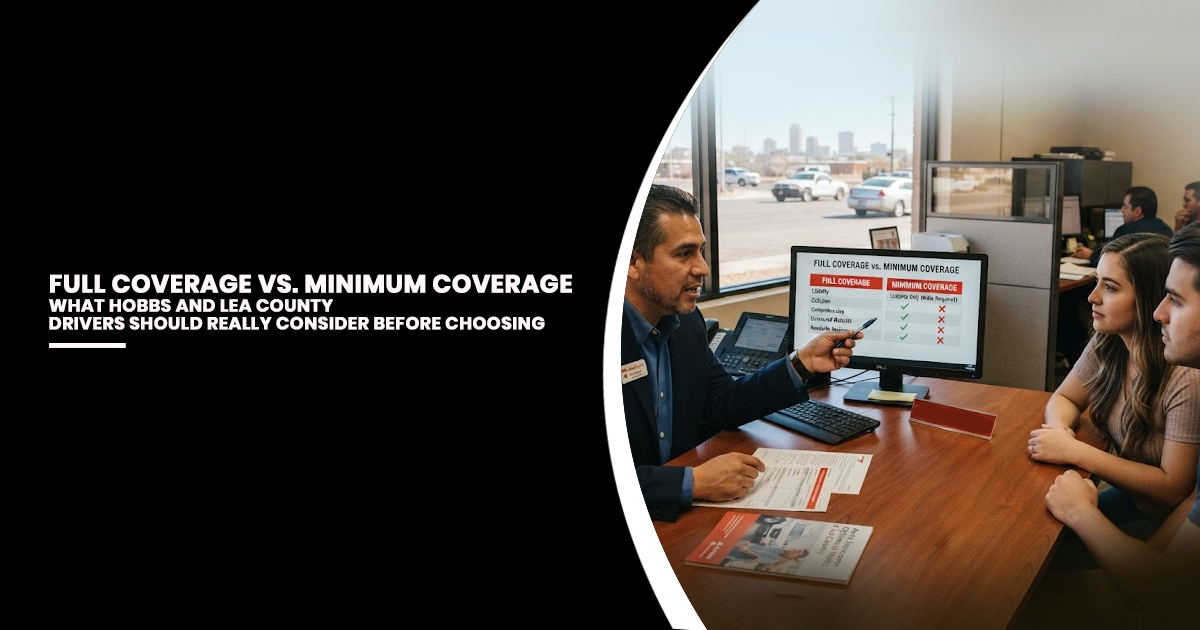
Full Coverage vs. Minimum Coverage: What Hobbs and Lea County Drivers Should Really Consider Before Choosing
Picture a routine Tuesday on West Bender Boulevard. A driver drifts out of the turn lane, clips your front quarter panel, and leaves before you can get a plate. You’re fine. Your truck isn’t. Then the repair estimate comes back at $6,000.
Here’s the moment that matters: the coverage you chose months earlier can determine how much of that bill comes out of your own pocket.
In New Mexico, that decision deserves particular attention because the state has a relatively high rate of uninsured drivers.
So let’s answer a question many Lea County drivers have before renewal: What is full coverage auto insurance, how is it different from New Mexico’s minimum coverage, and which option makes sense for you?
What Is Full Coverage Auto Insurance?
Full coverage auto insurance is not one legally defined product — it’s shorthand for a policy that combines liability coverage with two add-ons: collision and comprehensive. Liability pays for the other party’s injuries and property; collision and comprehensive pay to repair or replace your own vehicle. Together they cover both sides of a crash instead of only the damage you cause to someone else.
That distinction is the whole ballgame. Minimum coverage in New Mexico protects other people from you. Full coverage adds protection for you and your own car — from a wreck, a hailstorm off the Llano, a theft, or a deer on Lovington Highway. Here’s the plain-language breakdown of the three pieces:
Liability: Pays the other driver’s medical bills and vehicle repairs when you’re at fault. It never pays for your own car or your own injuries.
Collision: Collision generally covers covered damage to your vehicle from a collision, subject to your policy terms and deductible.
Comprehensive: Pays for non-crash damage: theft, vandalism, fire, flooding, hail, and animal strikes. Lenders usually require it.
If you finance or lease, “full coverage” isn’t really optional — your lender almost always requires collision and comprehensive until the loan is paid off. Own your car outright, and the choice is genuinely yours.
Why Does Full Coverage Exist If New Mexico Only Requires the Minimum?
Full coverage exists because the state minimum was designed to protect other people — not you. New Mexico law requires only 25/50/10 liability: $25,000 in bodily injury per person, $50,000 per accident, and $10,000 in property damage. That’s the floor to drive legally, and it does nothing for your own vehicle.
Those limits are lower than they look. A single new pickup can cost four or five times the $10,000 property damage minimum to replace. As an alternative to a policy, the state does let you post a surety bond or make a $60,000 cash deposit with the New Mexico State Treasurer — but almost nobody does that.
There’s a second reason full coverage matters more here than in, say, Maine. New Mexico has one of the highest uninsured-driver rates in the country. According to the Insurance Research Council’s 2025 study using 2023 claim data, 24.1% of New Mexico motorists were uninsured — versus a national rate of 15.4%. Roughly one in four drivers around you may have no way to pay for the damage they cause.
That’s why the state also leans hard on uninsured/underinsured motorist coverage. New Mexico requires insurers to offer uninsured/underinsured motorist coverage, subject to the state’s applicable requirements. If you decline or select lower UM/UIM limits, the required rejection or selection process must be followed. When one in four drivers is uninsured, your own coverage can be especially important when the at-fault driver doesn’t have enough insurance to cover your losses.
How Does Full Coverage Actually Work After a Crash in Hobbs?
If you rear-end someone on North Turner, your liability pays their damages, and your collision pays to fix your car — minus your deductible. If a hailstorm dents your hood in the driveway, comprehensive handles it. The deductible is the part you pay before coverage kicks in, usually $250 to $1,000.
Walk through a real-world example. Say you carry collision with a $500 deductible, and a distracted driver with no insurance sideswipes you, causing $6,000 in damage. Here’s how the money moves:
With minimum coverage only: Nothing pays for your car. You either chase an uninsured driver in small-claims court or eat the $6,000 yourself.
With full coverage plus UM: With collision coverage, your policy may cover the vehicle damage, subject to your deductible. Depending on your policy and the circumstances, uninsured-motorist property-damage coverage may also apply.
That gap is the entire argument for full coverage in a high-uninsured state. UM/UIM protection is also relatively inexpensive to bolt on — it typically adds $86 to $199 per year, roughly 5% to 10% of a premium, and can pay out tens of thousands when an uninsured driver hits you. For most Hobbs drivers, that math is not close.
Full Coverage vs. Minimum Coverage for Lea County Drivers: What Actually Differs
Minimum coverage pays only for the other person’s losses, while full coverage also repairs or replaces your own vehicle. Minimum is the cheaper monthly bill; full coverage is the smaller bill after a wreck. One protects your budget today, the other protects your assets on the day something goes wrong.
The price spread is real but narrower than many drivers assume. According to MoneyGeek’s June 2026 figures, New Mexico drivers pay about $116 per month for full coverage and $50 per month for minimum coverage. NerdWallet’s April 2026 analysis puts minimum coverage even lower, at an average of $473 per year. Here’s a side-by-side of what each buys you:
Feature | Minimum (25/50/10) | Full Coverage |
|---|---|---|
Other driver’s injuries & property | Yes, up to state limits | Yes, usually at higher limits |
Your own vehicle (crash) | No | Yes (collision) |
Theft, hail, fire, animal strike | No | Yes (comprehensive) |
Required by a lender? | Not enough | Yes, if financed or leased |
Typical NM monthly cost | Around $50 | Around $116 |
If you want the exact statutory limits and penalty details spelled out, our companion breakdown of New Mexico’s 25/50/10 minimum requirements covers the legal floor line by line. This piece is about deciding which side of that line fits your situation.
Who Should Choose Minimum Coverage Over Full Coverage in New Mexico?
A common rule of thumb: if your annual collision-plus-comprehensive premium approaches 10% of your car’s actual cash value, dropping them starts to pay off. On a paid-off vehicle worth $2,500, spending $600 a year to insure it against damage rarely adds up.
Minimum coverage tends to fit drivers who own an older, low-value vehicle outright, drive very few miles, and have enough savings to replace the car out of pocket if it’s totaled. If any of those isn’t true, the equation shifts. Full coverage usually wins for drivers who:
Finance or lease: Your lender contractually requires collision and comprehensive, so it’s not really a choice.
Drive a newer or higher-value vehicle: The more your car is worth, the more you stand to lose without collision coverage.
Can’t easily absorb a $6,000 hit: If replacing the car out of pocket would hurt, the deductible model is the safer bet.
There’s a local wrinkle worth naming. With roughly a quarter of New Mexico drivers uninsured, “the other guy’s insurance will cover it” is a bet you lose about one time in four. That’s a big reason we rarely recommend bare-minimum coverage for a car someone still relies on daily around Hobbs and Lea County.
What Do Hobbs Drivers Get Wrong About Full Coverage?
The biggest misconception is that “full coverage” means everything is covered. It doesn’t — the phrase has no legal definition, and even a robust full-coverage policy won’t pay for mechanical breakdowns, routine wear, or a rental car unless you added those features. It’s a bundle of specific coverages, not a magic blanket. A few others we hear often at our office:
Minimum is always cheaper in the long run: Only until the day you total a $30,000 truck an uninsured driver hit. One serious claim can erase years of premium savings.
25/50/10 is plenty for a bad wreck: A single hospitalization can blow past the $25,000 per-person bodily injury limit, leaving you personally liable for the rest.
Full coverage covers my own injuries automatically: Collision and comprehensive cover your vehicle, not your injuries. Medical Payments coverage can help with covered medical expenses regardless of fault, while UM/UIM bodily injury coverage can protect you when an uninsured or underinsured driver is responsible for the accident, subject to the policy terms.
Understanding Auto Insurance Coverage is exactly how you avoid an ugly surprise at claim time. The label is marketing; the declarations page is the truth.
How Our Team at Forrest Evans Insurance Approaches This
We don’t start with a product — we start with your car’s value, your loan status, and how much of a repair bill you could absorb without losing sleep. For a financed 2024 pickup, full coverage is a given, and the real conversation is deductible and UM limits. For a paid-off commuter worth $3,000, we’ll run the numbers honestly and sometimes tell you full coverage plus solid UM is the smarter spend. Forrest Evans Insurance, Incorporated has served Hobbs and Lea County since 1972, and our job is to match the coverage to your reality, not to sell you the biggest policy on the shelf.
FAQ: Full Coverage and Minimum Coverage in New Mexico
Is full coverage legally required in New Mexico?
No. New Mexico legally requires only 25/50/10 liability coverage — $25,000 bodily injury per person, $50,000 per accident, and $10,000 property damage. Full coverage is optional under state law. However, if you finance or lease your vehicle, your lender almost always requires collision and comprehensive coverage in the contract, which effectively makes full coverage mandatory until the loan is paid off.
What is the difference between full coverage and liability insurance?
Liability insurance pays only for the other party’s injuries and property when you cause a crash. Full coverage adds collision and comprehensive, which pay to repair or replace your own vehicle after a wreck, theft, hail, fire, or animal strike. In short, liability protects other people from you; full coverage also protects you and your car.
How much does full coverage cost in New Mexico in 2026?
New Mexico drivers pay roughly $116 per month for full coverage and about $50 per month for minimum coverage, according to MoneyGeek’s June 2026 data. Your actual rate depends on age, driving record, ZIP code, vehicle value, and deductible. Rates vary widely between carriers, which is exactly why comparing several quotes usually saves money.
Does full coverage pay for my own medical bills?
Not by itself. Collision and comprehensive cover your vehicle, not your body. To cover your own injuries, you’d add MedPay or rely on uninsured/underinsured motorist bodily injury coverage, which pays medical costs regardless of fault. In New Mexico, UM/UIM matters a great deal because so many drivers on the road carry no insurance at all.
Should I drop full coverage on an older car?
Consider dropping collision and comprehensive when their combined annual premium approaches about 10% of your car’s actual cash value. For a paid-off vehicle worth a few thousand dollars, the premium can exceed what the insurer would ever pay out. If the car is financed, still valuable, or hard to replace out of pocket, keeping full coverage usually makes more sense.
Why is uninsured motorist coverage such a big deal in New Mexico?
Because New Mexico has one of the highest uninsured-driver rates in the nation — about 24.1% in 2023, per the Insurance Research Council, versus 15.4% nationally. When roughly one in four drivers can’t pay for the damage they cause, your own UM/UIM coverage often becomes the only source of payment. It typically adds only $86 to $199 per year.
Does full coverage cover a rental car or roadside assistance?
Not automatically. Rental reimbursement and roadside assistance are separate optional add-ons, not part of standard collision and comprehensive. If you’d need a rental while your car is in the shop, ask to add rental reimbursement — it’s usually inexpensive. This is a good example of why “full coverage” doesn’t literally mean every possible expense is covered.
Ready to Compare Full Coverage and Minimum Coverage?
We’ll run the numbers on your specific vehicle, explain the trade-offs in plain language, and help you land on the coverage that fits your situation and your budget.
Forrest Evans Insurance, Incorporated has been helping Hobbs, New Mexico and Lea County families and businesses navigate auto coverage for over 50 years.
No pressure. No sales pitch. Just a straightforward conversation about what makes sense for you.
+1-575-255-0516Hobbs, New Mexico