


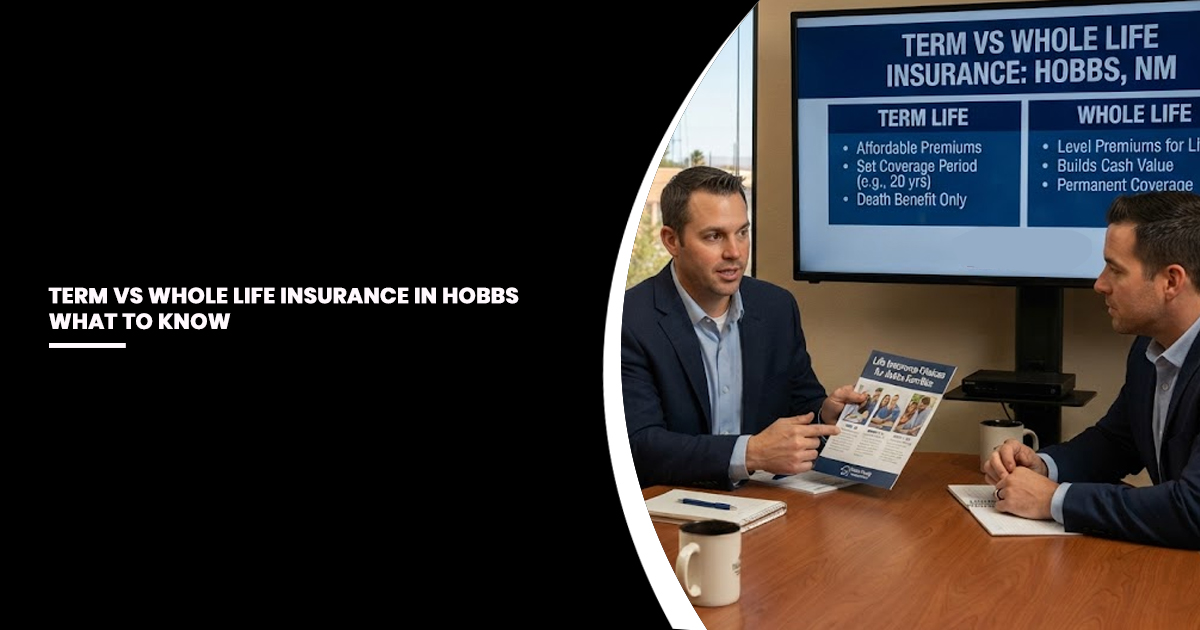
Term vs Whole Life Insurance in Hobbs: What to Know
Term vs whole life insurance can feel confusing when a mortgage, a growing family, and a new life-insurance question all arrive at once. You just closed on a house off West Bender, the second baby is on the way, and the paperwork from the mortgage company mentions life insurance in a way that suddenly feels less optional. So you start reading, comparing what each policy is designed to do instead of assuming one is right for everyone.
this decision isn’t actually that complicated once someone explains it in plain English instead of insurance-speak. It only feels overwhelming because most of what’s online is written to sell you the more expensive option.
The right policy isn’t the fancy one — it’s the one that fits your family and your budget.
We’ve been helping Hobbs and Lea County families sort out this question since 1972. Let’s walk through whole life insurance versus term life insurance in plain English: what each policy is designed to do, what to compare, and which questions to ask about your situation.
Why Does This Comparison Matter in Hobbs, New Mexico?
It matters because families in Hobbs and Lea County may have different protection goals, from replacing income during working years to covering a lifelong obligation. A local comparison can start with the policy term, the death benefit, exclusions, and how premiums fit the household budget.
Consider the protection your household would need if income stopped: a mortgage, childcare, debts, and final expenses may all matter. A life-insurance conversation should account for those obligations and the policy terms, not rely on a generic national example.
Term Life Insurance — Honest Pros and Cons
Term life insurance covers you for a set period — usually 10, 20, or 30 years — and pays a death benefit only if you pass away during that window. It’s the lowest-cost way to buy a large amount of protection, which is why it fits growing families so well. Think of it like renting coverage for the years your loved ones depend on your paycheck the most.
Premiums vary with age, health, tobacco use, coverage amount, term length, and carrier underwriting. The useful comparison is the protection period and what happens when the term ends, not a price pulled from a national sample.
Big coverage, small premium: You can protect a mortgage and years of lost income for the price of a couple of tanks of gas.
Simple and predictable: Your premium is locked in and level for the whole term, so there’s no guessing.
It expires: When the term ends, coverage stops. Renewing at an older age costs significantly more.
No cash value: If you outlive the term, you don’t get money back. That’s the trade-off for the low price.
One honest caveat: smoking or tobacco use can materially change underwriting and premiums. Tell the agent about tobacco use so the comparison reflects the carrier’s actual questions and rules.
Whole Life Insurance — Honest Pros and Cons
Whole life insurance covers you for your entire life and builds a savings component called cash value that grows over time. It never expires as long as you pay the premiums, and part of what you pay accumulates as money you can borrow against later. Think of it as owning coverage rather than renting it.
Whole life premiums are typically higher because the policy is designed for lifelong coverage and includes cash value. Compare the guaranteed elements, non-guaranteed illustrations, fees, and what happens if a premium is missed.
Lifelong protection: Coverage stays in force at any age, which matters for final expenses and estate planning.
Cash value growth: A portion of every premium builds a balance you can borrow against or withdraw later.
Level premiums: The rate is set when you buy and doesn’t climb as you age.
Much higher cost: The same dollar buys far less death benefit than term, so budget-strained families often end up underinsured if they force it.
Whole life earns its keep for specific goals — leaving an inheritance, covering funeral costs no matter when you pass, or funding a special-needs dependent’s future. It’s a real tool. It’s just not the default answer for everyone, no matter what a national sales script suggests.
Term Life vs Whole Life Insurance: The Honest Comparison
The biggest difference is simple: term is temporary, while whole life is designed to remain in force for life and includes a cash-value feature. Compare the coverage period, premium commitment, cash-value terms, exclusions, and how each option fits the goal you are trying to cover.
Feature | Term Life | Whole Life |
|---|---|---|
Premium factors | Varies by age, health, term and carrier | Varies by age, health, policy and carrier |
Coverage length | 10–30 years | Entire life |
Cash value | None | Yes, grows over time |
Premium stability | Level during term | Level for life |
Best fit | Income and mortgage protection | Lifelong and estate needs |
For many working Hobbs families, term coverage may be considered for time-limited income protection, while whole life may be considered when the need is intended to last for life. The right comparison depends on the household’s goals, budget, and the policy details.
Who Should Choose Term Over Whole Life in Hobbs, New Mexico?
Consider term life when the goal is replacing income or protecting a family during a defined period. Consider whole life only after reviewing whether a lifelong need, cash-value feature, and premium commitment fit your goals. Ask for the policy details in writing.
If you’re a young family on a budget: A 20- or 30-year term covers the kids until they’re grown and the house until it’s paid.
If you’re an oil field or truck worker protecting a paycheck: Term lets you buy a large death benefit that matches your family’s real income needs affordably.
If your need has an end date: Coverage that ends when the mortgage is paid and the kids are launched is a feature, not a flaw.
If you want permanent coverage and can afford it: That’s when whole life moves to the front — for final expenses, an inheritance, or estate planning that never expires.
Sometimes a household compares a larger term policy with a smaller permanent policy for separate goals. If you are considering that approach, ask how the policies coordinate, what each costs, and which guarantees are actually in the contract. We compare options around your stated needs and budget.
What Does Whole Life Insurance vs Term Life Insurance Look Like in Real Life?
In real life, the right choice depends on the season of life you’re in — and the same family often needs different answers ten years apart. Here are three composite situations we see regularly around Hobbs and Lea County.
The young worker and growing family. A household with a new baby and a mortgage may compare term coverage for income-replacement years with permanent coverage for a lifelong goal. The useful next step is to review the household budget, obligations, and policy terms rather than assume one product fits everyone.
The couple with grown children. When the mortgage is nearly paid and the goal shifts toward final expenses or leaving something behind, a household may compare permanent coverage. Review the premium commitment, cash-value terms, and beneficiaries before deciding.
The small-business owner who wants both. A Hobbs shop owner in her 40s carries a large 20-year term policy to cover business debt and income, plus a small whole life policy so her family never has to scramble for final expenses. That layered approach protects the near-term risk cheaply and locks in the permanent piece for good.
How Do You Decide Between Whole Life and Term Life for Your Family?
Start with one question: is the need temporary or permanent? A defined income-replacement period may point toward comparing term coverage, while a lifelong obligation may prompt a whole-life comparison. The answer depends on the family’s goals, budget, health information, and the policy contract.
From there, check what you are protecting, be honest about the budget, and compare the policy details. Ask about exclusions, conversion rights, cash value, beneficiaries, and what happens if circumstances change. Buying early can affect underwriting, but the carrier’s rules and your facts control the offer.
FAQ: Term and Whole Life Insurance Questions for Hobbs Families
What is the difference between term and whole life insurance?
Term life insurance covers you for a set number of years and pays a death benefit if you die during that period, while whole life insurance is designed for lifelong coverage and includes cash value. Term is often less expensive for the same death benefit, but the trade-off is that term expires and whole life has different premium and cash-value terms.
Is term or whole life insurance better for a young family?
Term life can be one option for a young family because it may provide income protection during years when children and a mortgage depend on earnings. Compare the coverage amount, term length, premium commitment, conversion provisions, and exclusions. Whole life is a separate option when the goal is intended to be lifelong.
Can I switch from term to whole life later?
Yes, many term policies include a conversion option that lets you switch to permanent coverage without a new medical exam, usually within a set window. This is valuable if your health changes or your needs become permanent. The rules and deadlines vary by carrier, so it’s worth confirming the conversion terms before you buy — that’s one of the specifics we review with families up front.
Does whole life insurance actually build cash value I can use?
Yes, a portion of each whole life premium accumulates as cash value that grows over time, and you can borrow against it or withdraw from it later. Keep in mind it builds slowly in the early years, so it’s a long-term feature, not a quick savings account. Any loan you don’t repay reduces the death benefit your family receives.
How much life insurance do I actually need?
Start with the household’s actual obligations: income replacement, mortgage and debts, childcare, education goals, and final expenses. There is no universal coverage multiple that fits every family. A licensed agent can help compare scenarios, but the policy terms and your circumstances determine the appropriate discussion.
Is life insurance more expensive if I work in the oil field?
Certain occupations and activities can affect underwriting, but rates and eligibility depend on the carrier, the application, health information, tobacco use, and the policy requested. Ask how an independent agency compares carriers and what information each one needs.
Why do people overestimate the cost of life insurance so much?
People often picture permanent-policy premiums when they imagine life insurance, even though term and whole life work differently. An actual comparison is more useful than a generic estimate, so ask for the assumptions, policy terms, and carrier information behind any quote.
Ready to Compare Your Life Insurance Options?
Call our Hobbs office and we’ll run the comparison, explain the trade-offs in plain English, and help you pick the coverage that fits your family’s budget and goals — no pressure, just honest advice.
Forrest Evans Insurance, Incorporated has been helping Hobbs, New Mexico and Lea County families protect what matters since 1972.
Because we compare policies from multiple carriers, we can put the coverage that actually makes sense for you ahead of any single company’s sales pitch.
No pressure. No sales pitch. Just a straightforward conversation about what makes sense for you.
Schedule your free life insurance review
+1-575-255-0516Hobbs, New Mexico