

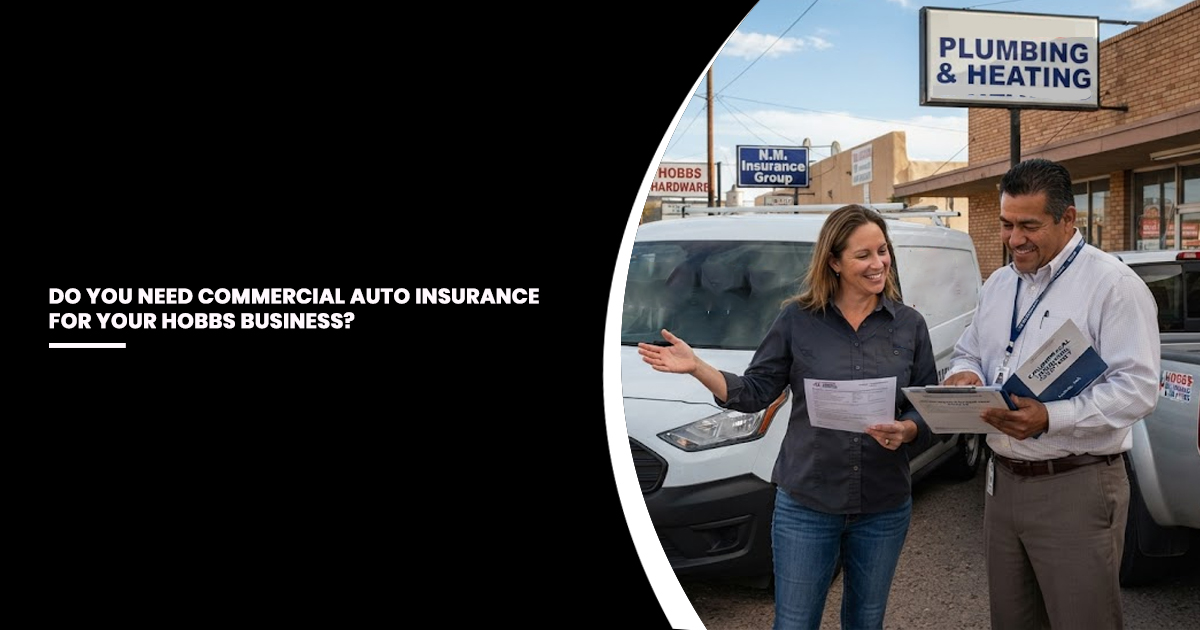
Do You Need Commercial Auto Insurance for Your Hobbs Business?
You bought a nice half-ton pickup, put your business name on the door, and started running it hard around Lea County — job sites, supply runs, the occasional trailer full of equipment out to a lease road. You’ve been paying your personal auto premium the whole time, on time, no complaints.
Then one afternoon on Lovington Highway, someone runs a light and clips you while you’ve got a load of materials in the bed and an employee riding shotgun. You file the claim, expecting it to go the way claims always have.
And the adjuster asks one question: “Were you using the vehicle for business?”
That single question is why so many Hobbs owners eventually ask us the same thing: “Do I need commercial auto insurance, or am I fine with what I’ve got?” Here’s the full picture, explained plainly — how personal and commercial coverage actually differ, where the line sits, and what it means for a business operating in Hobbs, New Mexico.
What Is Commercial Auto Insurance?
Commercial auto insurance is a policy built to cover vehicles used for business — the hauling, the client visits, the deliveries, and the employee driving that a personal auto policy is specifically designed to exclude. It typically carries higher liability limits than a personal policy because a business has more assets exposed in a lawsuit. In New Mexico, where the minimum required liability is only 25/50/10, that higher-limit protection matters more than most owners realize.
The core idea is simple. A personal policy insures you and your household; a commercial policy insures your business and the people who drive on its behalf. The vehicle can look identical — same pickup, same VIN — but the way it’s used changes which policy is supposed to respond when something goes wrong. That’s the distinction the whole question turns on, and it’s the one adjusters look at first.
Why Does Commercial Auto Insurance Even Exist?
Commercial auto exists because business driving creates risks a personal policy was never priced to cover: more miles, heavier loads, employees behind the wheel, and deeper pockets for a plaintiff’s attorney to reach. Insurers separate the two so that personal premiums stay affordable for ordinary family driving and don’t quietly subsidize a delivery route or a contracting crew.
Here’s what the insurance industry doesn’t spell out clearly: personal auto policies can restrict or exclude certain business uses, but the exact exclusions and permitted uses vary by policy and insurer. It’s not fine print buried to trick you — it’s the whole reason commercial coverage is a separate product. If a claim is excluded because of business use, you could be left responsible for damages and legal costs that the excluded coverage would otherwise have addressed.
That’s the origin of the whole category. Two different risks, two different policies. If your truck is part of how you make money in Hobbs, the personal side of that split was never really built for you.
How Do I Choose Between Personal and Commercial Auto Insurance?
You choose based on how the vehicle is used, not what it looks like or whose name is on the title. If the driving is tied to earning money — hauling tools, making deliveries, visiting job sites, transporting employees, or carrying business goods — commercial auto is the policy built to respond. If it’s commuting, errands, and family driving, a personal policy fits.
The gray zone is where Hobbs owners get burned. Some carriers allow limited “incidental” business use on a personal policy, but the definitions are narrow and vary by insurer, and driving to a job site is generally treated as business use that a personal policy can deny. Here’s a test that cuts through it:
Whose name is the vehicle registered and titled under: If the vehicle is owned by an LLC or the business itself, it generally needs to be insured under a commercial auto policy or other appropriate business coverage.
Who drives it: Regular employee use can require commercial coverage, depending on the policy and how the vehicle is used.
What it hauls: Tools, inventory, materials, or client goods point to commercial use — not a trip to the grocery store.
How it earns: If the vehicle stops, does revenue stop with it? That’s the clearest signal you’re running a business vehicle.
Run those four honestly. If two or more land on the business side, you’re not really choosing anymore — the exposure has already chosen for you.
What Happens When a Personal Policy Denies a Business-Use Claim?
When a personal auto carrier denies a claim for business use, you’re personally on the hook for everything — the other driver’s medical bills, their vehicle, your own repairs, and any lawsuit that follows. There is no coverage backstop, because the policy that would have responded was the commercial one you didn’t buy.
Picture a realistic Hobbs scenario. A framing contractor’s employee is running to a Hobbs hardware store for supplies mid-job and rear-ends someone on North Turner. If the employee’s personal policy excludes the business use, the business could still face liability for the accident. That exact pattern, an employee on a work errand getting a claim denied, is one insurance professionals see repeatedly. The vehicle looked personal right up until the moment it mattered, and then it counted as business.
This is also why New Mexico’s bare-minimum limits are a trap for business drivers. With property-damage liability starting at just $10,000 under the state’s 25/50/10 minimum, one serious wreck involving a work truck can blow through the limit and leave the business paying the rest. Commercial policies are written with higher limits precisely because business wrecks tend to cost more.
What Does Commercial Auto Mean for a Small Business in Hobbs, New Mexico?
For a Hobbs small business, commercial auto means the difference between a covered accident and a personal financial hit that can follow you for years. It protects the business’s assets, covers employees who drive on the clock, and carries limits sized for the way lawsuits against businesses actually play out. And it’s more affordable than most owners assume.
Cost is usually the first worry, so here are real numbers. According to Insureon, small businesses pay an average of $245 per month for commercial auto insurance, with annual premiums ranging from under $375 to over $16,000 depending on vehicles, drivers, and cargo. Insurance.com, citing Insureon, puts the median closer to $147 per month — a reminder that a single low-mileage work truck often lands well under the headline average. A policy priced right is one a Hobbs owner can actually keep.
The energy-heavy economy around Hobbs and the wider Permian Basin means a lot of local businesses run trucks, trailers, and service vehicles as core equipment. If you operate heavier trucks or haul freight, the coverage conversation deepens — our complete truck insurance guide for New Mexico owner-operators and fleets walks through limits, filings, and fleet structure in detail. And if the vehicle is one piece of a broader operation, our overview of small business insurance for Hobbs owners shows how auto fits alongside your other coverage.
Who Should Carry Commercial Auto Instead of a Personal Policy?
You should carry commercial auto if you own a vehicle in a business name, employ anyone who drives for work, haul tools or goods, or use a vehicle to deliver products or services. If any of those describe your day, a personal policy is the wrong tool and a denial is a real risk. This is the single most common source of coverage gaps we see with Lea County businesses.
The businesses that most often need it:
Contractors and trades: Anyone hauling tools, ladders, or materials to a job site — the classic Hobbs work-truck situation.
Oilfield and service companies: Vehicles running lease roads and job locations across the Permian Basin, often with employees driving.
Delivery and courier operations: Delivery work can be excluded or restricted under a personal auto policy, depending on the insurer and policy.
Any business with employee drivers: Once someone other than you regularly drives for the business, the exposure jumps.
There’s also a coverage most owners have never heard of. If your employees drive their own cars for work errands — the milk-run-for-the-office scenario — HNOA provides liability coverage for a business when employees use their own vehicles for business purposes, subject to the policy’s terms and other available insurance. Plainly: if the driving earns money, someone needs a business policy attached to it.
Common Misconceptions About Needing Commercial Auto
The biggest misconception is that a vehicle titled in your own name is automatically fine on a personal policy — it isn’t, because coverage turns on use, not ownership. That single misunderstanding causes more denied claims than any other. A few more worth clearing up:
“I only need commercial auto for a big rig.” Not true. A single pickup used for a contracting business needs it too. Size doesn’t determine the requirement — business use does.
“My employee’s own insurance automatically covers business driving.” Not necessarily. Coverage for business use varies by personal policy, which is why businesses should review their commercial auto and HNOA needs.
“Commercial auto is too expensive to bother with.” Insureon reports an average commercial auto premium of about $245 per month for its small-business customers. The math rarely favors going without.
“Cargo is covered as long as I have liability.” Liability covers what you damage — not the goods in your truck. That’s a separate gap our piece on motor truck cargo insurance in New Mexico breaks down.
Clear those four up and the “do I need it” question usually answers itself before we finish the conversation.
How Does Our Team at Forrest Evans Insurance, Incorporated Approach This?
We start with how you actually use your vehicles, then match coverage to that reality — not the other way around. That means honest questions about who drives, what they haul, whose name the title’s in, and how far the exposure really reaches. Forrest Evans Insurance, Incorporated has served Hobbs and Lea County since 1972, and in that time the fastest way to leave a local owner exposed has always been a policy that doesn’t match how the work gets done.
We’d rather find the gap now, at the kitchen table, than have you find it after a wreck on the highway.
FAQ: Commercial Auto Insurance Questions for Hobbs Business Owners
Does personal auto insurance cover business use?
Usually not. Nearly every personal auto policy contains a business-use exclusion that lets the carrier deny claims when the vehicle was being used for work, and driving to a job site is generally treated as business use. Some insurers allow limited “incidental” business use, but the definitions are narrow and vary by carrier. If your vehicle regularly earns money, a commercial policy is the one designed to respond.
How much does commercial auto insurance cost?
Small businesses pay an average of about $245 per month for commercial auto insurance, according to Insureon, with annual premiums ranging from under $375 to over $16,000. Insurance.com puts the median closer to $147 per month. A single work truck may cost less than a larger commercial fleet, but premiums vary significantly based on the vehicle, business use, location, drivers, limits, and other factors.
What’s the difference between commercial and personal auto insurance?
Personal auto insures you and your household, while commercial auto insures your business and the people who drive on its behalf. Commercial policies also carry higher liability limits because businesses have more assets exposed in a lawsuit. The vehicle can be identical — the coverage difference comes down to how it’s used.
Do I need commercial auto insurance if I only use one truck for my business?
Yes, most likely. Commercial auto is triggered by business use, not the number or size of vehicles. A single pickup used for business may need commercial auto coverage, depending on how it is owned, used, and insured. The one-truck operation is exactly where personal-policy denials tend to surprise owners.
What are New Mexico’s minimum auto liability requirements?
New Mexico requires drivers to carry 25/50/10 liability coverage — $25,000 bodily injury per person, $50,000 per accident, and $10,000 for property damage. As an alternative, the state allows a surety bond or a cash deposit with the state treasurer. For a business vehicle, those minimums are dangerously thin, since a single serious wreck can exceed the $10,000 property-damage limit fast.
What is hired and non-owned auto insurance?
Hired and non-owned auto (HNOA) is liability coverage that protects your business when employees drive vehicles the company doesn’t own — their own cars or a rental — for work purposes. It steps in when an employee’s personal insurance denies a business-use claim, which shields the business from being sued directly. It’s an inexpensive add-on that closes a gap many small businesses don’t know they have.
Will my insurance company drop me for using a personal vehicle for business?
They can, if they discover regular business use that wasn’t disclosed. More commonly, the carrier keeps the policy but denies any claim that involved business use — leaving you paying out of pocket. Being upfront about how you use the vehicle lets your agent place the right policy before a claim ever happens, rather than after a denial.
Not Sure Which Side of the Line You’re On? Let’s Talk.
We’ll look at how you actually use your vehicles, point out where a personal policy would leave you exposed, and quote commercial coverage at a competitive rate that fits how your business runs.
Forrest Evans Insurance, Incorporated has been helping Hobbs, New Mexico and Lea County families and businesses protect what they’ve built since 1972.
No pressure. No sales pitch. Just a straightforward conversation about what makes sense for you.
Call or visit us for a free coverage review
+1-575-255-0516Hobbs, New Mexico